Showing posts with label Saint Sophrony of Essex. Show all posts

Saturday, February 18, 2023

Our choice in Christ.
St. Sophrony the Athonite


Saint Sophron the Athonite.


    Christ is miracle beyond comprehension. He is the all-perfect revelation of God. He is also the all-perfect manifestation of man.

Everyone of us will at some moment be brought to the in­visible border between time and eternity. Arriving at this spiritual boundary-line, we shall have to determine our future in the world that lies before us, and decide either to be with Christ, in His likeness, or to depart from Him. Once the choice ­to identify with Christ or to refuse Him-has been made, of our own free will, for all eternity, time will no longer function.

Saturday, January 28, 2023

Praying for the sick.
St. Sophrony the Athonite


Jesus heals the Canaanite's daughter.

It is not at all easy for a monk to bear the burden of being a confessor. On the one hand it is beneficial for him personally when people think poorly of him, since censure fosters humility. More urgent prayer rises to God from the ailing heart. It is easier for him to cry to God for the salvation of the world, since he himself exists by suffering, like the suffer­ing of the great majority of the inhabitants of the earth. On the other hand, if he is engaged in the work of a spiritual father, every negative word about him instils distrust in him on the part of people in need of exhortations, comfort and support. His sorrow is twofold: for himself as being unworthy of his calling, and then for the harm brought on the whole Church, on all mankind, when the authority of the priest is undermined. Unheeding a spiritual father's injunctions is tantamount to rejecting the word of Christ Himself. (He that heareth you heareth me; and he that despiserh you despiseth ... him that sent me,")

Saturday, December 17, 2022

The Word of the Father.
St. Sophrony the Athonite


Saint Sophrony the Athonite.

        “He that hath seen the Son hath seen the Father” (john 14:9). “He that hateth the Son hateth the Father also” (cf John 15:23). “He that believeth on the Son hath ever­lasting life: and he that believeth not the Son shall not see life; but the wrath of God abideth on him” (john 3:36).

Through the Holy Spirit, “Which proceedeth from the Father” and reposes in the Son, we know the Son in His Divinity and in the nature of man that He assumed. It is in the Holy Spirit that we live the Father.

Saturday, September 17, 2022

The action of God in us.
Saint Sophrony the Athonite.


Saint Sophrony the Athonite.
        Nowadays there are people all over the world in search of a solution to their quest. This widespread unallayed spiritual thirst is a historical event that is really tragic. Many are on the edge of despair. Every one of them, according to his own measure, in the depths of his spirit suffers from the absurdity of contemporary life. They are inconsolable in their grief; their own individual efforts are not enough to free them from the enclosing world of confusion, and stay their minds on the most important thing of all.  

Ours is sometimes called the post-Christian age. But I personally, from what I know of the history of the world and of Christianity, am convinced that Christianity in its true dimensions has never yet been properly grasped by the great mass of people. Kingdoms pretending to the name of 'Christ­ian', and their peoples, have worn the mask of piety, while 'denying the power thereof' They have lived, and live, like heathens. Strange as it may be, it is precisely the Christian countries who keep the greater part of the universe in the iron grip of slavery. In these latter years they have shrouded the world in a dark cloud of expectation of apocalyptic fire: 'the heavens and the earth, which are now ... reserved unto fire against the day of judgment and perdition of ungodly men.'

In the present crisis of Christianity among the popular masses it is quite justifiable to discern a rebellion of the natural conscience against the distortions which the Gospel teaching has suffered in its historical destinies.

We are living again in the atmosphere of the first centuries of our era: unto us 'it is given in the behalf of Christ, not only to believe on him, but also to suffer for his sake'. More than once have I rejoiced in the thought that, for the most part, my life has coincided with harassment of Christianity. This allows me the more acutely to feel myself a Christian, to realise the incomparable honour in times like these of following the only-begotten Son of the Father on His path to Golgotha. Persecution is rife everywhere but in different forms - none of which, however, is easy to bear. May the God of love deliver every soul from the calamity of being a tormentor even of 'one of these little ones'.

In 'suffering for his sake ' there is an especial blessing and even election: he who suffers, by the very force of circumstances places himself in constant association with Jesus Christ, is led into the sphere of Divine love and becomes God-bearing.

There are two ways for theology: the one, widely familiar in previous centuries, appertaining to the professional theo­logian; the other, which means being crucified with Christ. knowing Him in the secret places of the heart. The first of these types is accessible to the majority of the intellectually endowed having a preference for philosophical subjects - genuine belief in the Divinity of Christ expressing itself in a life lived according to the spirit of His commandments is not needed. The second is the theology of the confessors, which is born of a profound fear of God in the fiery flames of repentance, leading to existential reality through the appearance of Uncreated Light. Academic theology com­bined with living faith affords blessed results. But it can easily degenerate into abstract theory, and cease to be what we see in the lives of the Apostles, Prophets, Fathers - the direct action of God in us. 'No man can come to me, except the Father which hath sent me draw him ... It is written in the prophets, And they shall be all taught of God. Every man therefore that hath heard' [in his heart] 'and hath learned of the Father, cometh unto me'.

The Holy Trinity is the God of Love. The love of which the Gospel treats is the uncreated life-force of unoriginate Divinity. The property of this Love is to unite us in very being. He who dwells in this unity with God gradually grows to realize what is happening to him. 'But God hath revealed [knowledge of Him] unto us by his Spirit: for the Spirit searcheth all things, yea, the deep things of God ... We have received, not the spirit of the world, but the spirit which is of God: that we might know the things that are freely given to us of God. Which things also we speak, not in the words which man's wisdom teacheth, but which the Holy Ghost teacheth. 'Thou art the Christ, the Son of the living God'.

And as Jesus answered, 'flesh and blood hath not revealed it unto him [peter], but my Father which is in heaven'. 'Great is the mystery of godliness: God was manifest in the flesh, justified in the Spirit, seen of angels, preached unto the Gentiles, believed on in the world, received up into glory'. And this is natural growth in the Spirit through dwelling in the Divine realm by keeping Christ's commandments. The mind straightway apprehends knowledge and formulates it in human terms. It happens like a flash of lightning, when the heart is burning with love. This is the 'marvelous light' of eternity to which we are called.!..


Reference:

On Prayer. Archimandrite Sophrony Sacharove. 1996.

Saturday, August 27, 2022

Saint Sophrony’s touch.
Metropolitan Athanasius of Limassol.

 Elder Sophrony: a man who was perfect in Christ
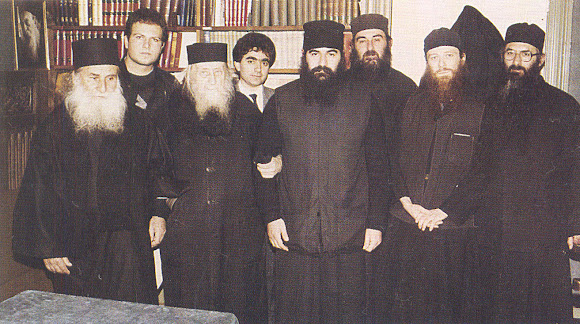
Elder Sophrony with various pilgrims to his Monastery,
 including Elder Joseph of Vatopedi, Metropolitan Athanasios of Lemesou, Elder Zacharias of Essex, and Elder Kirill

        It took place in winter, right before Christmas under the Julian calendar, somewhere around 1970. I had already read the book by St. Sophrony of Essex, We Shall See Him as He Is. It belonged to Geronda Dionysius of Dionysiou monastery, a spiritual and holy man who lived not far from elder Sophrony. I took the book from him and gave it to our Geronda Joseph, and we read it together. When we finished reading it, Geronda Joseph said: “He is a great saint!” He was impressed by the profound depth of the theological narratives, spiritual but not academic, and St. Sophrony’s unbelievable experience. Taking advantage of this state of “spiritual exaltation,” I said, “Geronda, why don’t we go and take a blessing from Elder Sophrony while he is still alive?” Geronda Joseph replied, “Well, but how can we get to England? Do you think, my child, it’s so easy?” I suggested: “Give me your blessing and I’ll take care of it.” He agreed. I was younger and livelier at the time than I am now, so I arranged our trip to England. And so, we, Geronda Joseph and I, made a short trip to England, arranging through one of our friends to meet with Elder Sophrony.

We went to the monastery straight from the airport and arrived there in the evening, about 11 pm. It was awfully cold. St. Sophrony was waiting for us at the gates, next to the monastery fence. He waited for us in this bitter cold, along with a few other brethren. As soon as Geronda Joseph got out of the cab, Elder Sophrony began to bow. He was crossing himself and bowing. He would bow down as low as his strength allowed—he was already advanced in years. We felt awkward. He hugged and kissed us, and said: “Welcome to England! Let’s go to church and pray.” We went to church and prayed. He commemorated our names in a very heartwarming way.

We remained in the monastery for two days and two nights. Throughout this time, we had meetings and conversations with Elder Sophrony. He shared his memories of the Holy Mountain, of Elder Joseph the Hesychast, St. Silouan, and spoke about his experience of concelebrating Divine Liturgy with him. We held conversations on various spiritual topics. What greatly impressed us was our very perception of the elder Sophrony. He was a man who was perfect in Christ. Geronda Joseph said of him, “If you desire to see a perfect man, look at this elder. If you wish to know how the Gospel transforms a man, look at him—he is indeed a man perfect in Christ.” Such was our impression. Afterwards, the elder Sophrony blessed us in all his goodness, both spiritual and human, talking to us in all seriousness and sublimity, welcoming us with all humility and love. The image of his holiness will always remain with us!


Father Paisius of Dionysiou: the “mother” of Christ
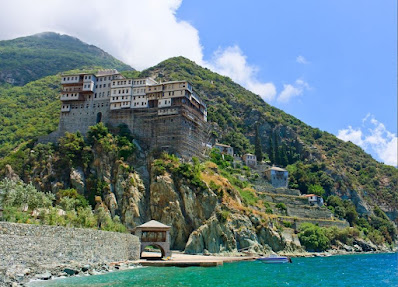
Monastery Dionisiou.

          A man of deeply inner life... He lived at Dionysiou.

A Cypriot, he grew up in South Africa and resided in England. He was very successful in his economic and commercial endeavors. At some point, he met St. Sophrony of Essex and turned to God. He arrived at the monastery of Dionysiou on Mount Athos and became a monk. He lived there in strict asceticism.

This monk’s life was a stellar example of monasticism. Scrupulous, inconspicuous, humble, replete with obedience and truly inscrutable. He never went anywhere and no one knew about him. He was bestowed with many gifts of the Holy Spirit. He was a man of unceasing prayer, a man of great love, a man enlightened by the Lord Who revealed to him His all-holy will about the people who saw him.

When I first came to the Dionysiou sometime in October or November of 1976, I was overcome with many thoughts about whether or not I should stay on the Holy Mountain. Once, in the evening I walked from the Monastery of St. Paul to Dionysiou, as they were having the Compline service there. I sat down in the side chapel. I knew no one (as an eighteen-year-old student) and certainly no one knew me either. So, I sat there, in my stasidia, in the side chapel of the Laudation of the Most Holy Mother of God, contemplating my life and watching the elders of the Dionysiou; they also sat deep in their stasidia immersed in the darkness of the cathedral and reading the Compline so simply, humbly, and quietly... I was seized with despair and frustration—so I sat there, awash with thoughts: What am I doing on this Holy Mountain? All they have are these elderly monks! They look like living corpses. I am going to leave this place at once! I had a feeling that I was visiting the kingdom of the dead in this monastery. As soon as I thought that, a monk came up to me—he was lighting the oil lamps in the cathedral—and said, “You shouldn’t think this way! The monks you see aren’t dead. They are not. These fathers are filled with life—life in Christ. But when man lives in Christ, it is truly life.” I thanked him and said nothing else. I didn’t know him, nor did I know anyone else there. However, as soon as I left, I realized that it was the answer to my thoughts.

I met this monk again later. His name was Father Paisios. He maintained order in the church, and since he was also a Cypriot, we got to know each other and became friends. Elder Gabriel of Dionysiou once said of him: “This monk is like the one described by St. Simeon the New Theologian—‘he is akin to the ‘mother’ of Christ.’” I asked: “What does that mean, the ‘mother’ of Christ?” Geronda replied, “Like a mother who carries a child in her womb, is aware of him, gives birth and becomes his mother, so does a man who strives in Christ. He “conceives” Christ in his being, in his heart, and becomes a God-bearing man. This monk is a ‘mother’ of Christ, because he has Christ in his heart.”

Of course, I stayed on Mount Athos. I also often visited Dionysiou. We held conversations with this holy elder, filled with sweetness, humility, love and obedience. He always comforted us with his appearance and the gentle and comforting words.

A man of unceasing prayer, he received the monastery’s blessing at the end of his life and went into the wilderness to the remote St. James Kathisma, remaining there almost to the end of his life, enjoying the life of a recluse, in silence and prayer.


Reference:

https://orthochristian.com/147202.html

Saturday, July 30, 2022

“Be of good cheer”.
Saint Sophrony the Athonite.


Christ with Elijah and Moses, upper part of the Transfiguration, murals in oil paint on gypsum plaster by Saint Sophrony and members of his community.  Monastery of St John the Baptist, east wall, mid 1980s.[44]  Image: ©The Stavropegic Monastery of Saint John the Baptist, Essex.


        The Jewish people looked for the coming of the Messiah who when he was come would tell them ‘all things’ (John 4.25). Come and live among us, that we may know Thee, was the constant cry of the ancient Hebrews. Hence the name ‘Emmanuel being interpreted is, God with us’ (Is. 7.14; Matt. 1.23).

So for us Christians the focal point of the universe and the ultimate meaning of the entire history of the world is the coming of Jesus Christ, Who did not repudiate the archetypes of the Old Testament but vindicated them, unfolding to us their real significance and bringing new dimensions to all things — infinite, eternal dimensions. Christ’s new covenant announces the beginning of a fresh period in the history of mankind. Now the Divine sphere was reflected in the searchless grandeur of the love and humility of God, our Father. With the coming of Christ all was changed: the new revelation affected the destiny of the whole created world.

Saturday, July 9, 2022

“Lovest thou me.?!.”
Saint Sophrony the Athonite.

The Old Rectory

 20th September 1977


Saint Sophrony the Athonite.
You say that you are getting old. So what can I say? I am 81 ! Incredible, but still a fact. In no way can I understand this strange situation. So many times I have been really seri­ously ill. So ill that those around me never supposed that I would recover and get up. So many times I was in danger in the mountains, in the desert, on journeys, in stormy weather at sea, and also from many tribulations and spiritual wounds, which perhaps no one can escape in our time. And what a wonder! I pray that you too will remain longer among the liv­ing. 'Old age is no joy', they used to say at one time, but still it can be a period of exceptional importance. On the one hand, it can make possible many deep experiences, and on the other, it can be a preparation, full of both fear and exultation, for our departure from here: from temporal things to things im­mutable and eternal.

Saturday, May 21, 2022

True Christian “poverty”.
Saint Sophrony the Athonite.


Saint Sophrony the Athonite.

       Experience shows every man that in order to arrive at pure prayer it is essential to free the mind from burdensome preoccupation with material possessions.

At first one argues: 'How can I liberate myself com­pletely from things? Through my body I am a material thing myself, and the life of this body of mine is inevitably bound up with the material. So does it mean that I must let myself die?' ... No, it is not like that. Wise ascetic effort consists in reducing to a minimum the material needs without the sat­isfaction of which it would be impossible to keep alive. But the measure of these needs differs in every case."?

Contemporary man has not been able to organize his life in such a way as to allow himself sufficient leisure - free time - for prayer and the contemplation of Divine Being. The reason for this is covetousness, that passion which St. Paul called 'idolatry' and St. John Climacus 'the daughter of unbelief ... blasphemy against the Gospel, a turning aside from God' .

Saturday, March 12, 2022

On icons and contemporary culture.
Saint Sophrony the Athonite.


The Old Rectory

 17th March 1969


Saint Sophrony the Athonite.

     Winter this year has been dreadful. It has probably never been like this so far in the twentieth century. Here, of course, there is not a vestige of the cold there is in your part of the world, but the prolonged 'autumn', damp and foggy, doesn't favour good health or inspiration for physical labour. And just now I could precisely do with a lot of physical strength, because we are under obligation to fulfil the huge amount of orders for icons. I would like at the same time to be free from every other occupation, so as to go deeper into the 'spirit' of the icon. You see, the power of the icon is truly a transfiguring power, especially in our century, when this spirit has been lost, when the feeling for beauty has been lost, when the very notion of 'beauty' has become vague, elusive - due, of course, to the cult of ugliness. In our time, strangely, the more dreadful the ugliness, the nearer it is to the soul of the one viewing it or hearing it. The past homage to beauty and harmony has become indigestible for 'new' people.

Saturday, March 5, 2022

On Departure.
Saint Sophrony the Athonite.


Saint Sophrony the Athonite.


        I think I have lived long enough, that there is no sense in prolonging this particular life, that I must 'depart'. Naturally, you have all grown old and like me are subject to illnesses; you too are getting ready for the in­evitable. But prepare with a sense of occasion, as if for the greatest moment of our earthly existence, and not with a feel­ing of despair and ingratitude.

 All of us must bear suffering in such a way that we live it not just as our own personal suf­fering, but as that of the human world. Through the experience of our sufferings we come to know cosmic life, we live the tragedy of all humanity, we widen our knowledge to the point where it reaches the limits of this world, where it surpasses these limits, where it attains to Infinity.

Saturday, February 5, 2022

The tragedy of the Fall.
Saint Sophrony the Athonite.


Saint Sophrony in his youth.

    Question:
You said that when man turns aside towards evil, he loses union with God - that's to say, a break takes place. But surely, this break is one-sided: doesn't man break with God, but not God with man?

Fr Sophrony: Yes. That's where the tragedy of the Fall lies - that God came and showed that He does not want to be separated from us, but man separates himself. What this means is that God does not coerce man.

So now we live through such dreadful events: war in Viet­nam, war in Nigeria, war in the Near East, famine in the world striking dead thousands and thousands of people. Logically it's clear to me that if man would live according to a different principle, it would be possible to sustain everyone. The re­sources expended for war, even when there is no war, surpass the resources required for the needs of all those who are per­ishing. In this connexion - I asked a man in England, 'If you had absolute power, what would you do to the people who seem to you to be guilty of this evil?' His answer was: 'If I had such absolute power, I couldn't act: this power would paralyse me.'

Saturday, January 22, 2022

Great Is The Name Jesus.
Saint Sophrony the Athonite.


Tomb of Saint Sophrony.
 Saint John the Baptist Monastery. Essex.

        Great is the Name I AM. Great the Name of the Holy Trinity. And great, too, the name JESUS. Much can be said of this Name of His. It is inexhaustible in its content. It belongs to Him to Whom everything that is owes its exist­ence. “All things were made by him; and without him was not anything made that was made. In him was life; and the life was the light of men.”. He was 'in the beginning' - that is, He is the principle of all the universe. In the inner life of the Trinity He is turned towards the Father; in the Act of creation that Logos addressed Himself to the creature in His image.

Saturday, December 18, 2021

My soul sings hymns of praise to God.!..
Saint Sophrony the Athonite.


Russian icon of the Nativity of our Lord.


        All that is preposterous and frightful in the outside world, everything that is banal and tedious in daily life, resolves into a contradictory yet grandiose tableau. Both the noble and the ignoble somehow or other find their reflection in each of us. The manifold contrasts - of evil and good, ignorance and light, grief and joy, folly and wisdom, love and hatred, weak­ness and strength, construction and destruction, birth and death - all go to form the all-embracing vision of Being. The innumerable multitude of vexations and insults imposed on us degrade and put us to scorn. The soul despairs before such a spectacle. And suddenly the meaning of Christ's words, 'A MAN IS BORN INTO THE WORLD' becomes clear in their eternal significance, eternal even for God. And for this joy all previous ills and sorrows are remembered no more.

Saturday, November 13, 2021

A Christian perspective.
Saint Sophrony the Athonite.


Saint Sophrony the Athonite.
What a misfortune to live in such unstable times. Millions and millions of people suffer all their lives. The whole history of mankind is a nightmare of ceaseless fratricidal wars. And up to this time this humanity remains - forgive the expression - as savage and bloodthirsty, as violent and criminal, as ever. The holy words "the meek [ ... ] shall inherit the earth", will undoubtedly come true at some as yet undefined moment, but thus far it is horror upon horror. This horror has grown in our time, because at each moment all the earth knows about more or less every event, and the events are for the majority gloomy and criminal. But let's hope against all hope that our meeting will take place, now that we are at the end of our sojourn here [on earth]. 

I can tell that your meeting with M. was both joyous and important for all of you. Of course she knew that you are living in poverty, and from that point of view she was not ex­pecting anything. The main thing is the peaceful communion, in love and confidence, between open souls. For our times that is a great thing. As long ago as the thirties Berdyaev was saying that to the degree that the social system is being im­proved, personal communication between people becomes more and more rare, and therefore more precious."Almost everywhere communication takes place on a political footing, or a business footing (for trade, industry, and suchlike), and more rarely on a basis of common spiritual interests, and even more rarely, simply as communion between one person and another.

Saturday, August 15, 2020

“Find a way to save the world”.
Saint Sophrony The Athonite.


Saint Sophrony with the Lord Jesus Christ.
Orthodox monastery of all Celtics Saints. England.
What I want to write of now happened over half a century ago. It was a period of strain. Much - practically everything - was a puzzle to me. And life is so short! And God so immeasurably great and far off! Who will show me the straight way to Him, prevent me from wasting time on alien paths? Of course I sought such a guide, or guides - preceptors who might help me. But the fact that I was caught up by a hitherto-unknown force in the form of prayer which stayed with me day and night naturally made prayer my constant prop. And there were times when prayer, so I believe, brought enlightenment from God.

Unable to glimpse the divine truth in the destinies of mankind, of people in general, and tormented by my own dark ignorance, I was like a small, utterly helpless child. Feeling that there was something that I had to understand, I writhed impatiently and looked to God for help. And the Lord took pity on my ignorance and was not angry at my temerity but like a mother had compassion on me and was quick to respond. And this not once but over and over again. In like manner He had handled Job who suffered so much and protested so stormily.

I remember one such happening, which occurred in France, in the early twenties - before my departure to Mt. Athos in 1925. I wept and prayed to God: “Find a way to save the world - to save all of us, we are all defiled and cruel.” I would pray with particular fervor for the “little ones”, the poor and oppressed. Towards morning, with my strength waning, my prayer would be disturbed by the thought that if I grieve for mankind with all my heart, how is it that God can look on indifferently at the pain and torment of millions of beings whom He Himself had created? Why does He allow the innumerable instances of brute force in the world? And I would turn to Him with the insane challenge, “Where art Thou?” And in my heart I heard: “Was it you who was crucified for them?”… The gentle words uttered by the Spirit shook me to the core - He Who was crucified had answered me as God.

Saturday, July 11, 2020

L’humilité : chez les Saints Silouane et Sophrony.
Mère Mariam Zacca.


Mère Mariam Zacca, Higoumène
 du monastère
Saint Jean-Baptiste. Douma. Liban.
Abba Antoine (saint Antoine le Grand) a dit : « J'ai vu tous les filets de l'Ennemi éten­dus sur la terre et je me disais en gémissant:"Qui pourrait passer au travers ?". J'enten­dis une voix qui me disait: "L'humilité" ».
Le Seigneur a dit dans son Évangile: «Venez à moi, vous tous qui peinez et ployez sous le fardeau. C'est moi qui vous soulagerai. Prenez sur vous mon joug et mettez-vous à mon école; je suis doux et humble de cœur ; et vous trouverez du soulagement pour votre être, car mon joug est agréable et mon fardeau est léger.» (Matthieu 11, 28-30)
C'est ce que notre Dieu Sauveur fait: «Il se mit alors à invectiver les villes où il avait fait la plupart de ses miracles; parce qu'elles n'avaient pas fut pénitence.» (Matthieu 11,20)
«Mais le Seigneur eut pitié de moi et m'enseigna lui-même comment il faut s'humilier : "Tiens ton esprit en enfer, et ne désespère pas." C'est ainsi qu'on triomphe des ennemis. Ainsi l'âme connaît par expérience les ravages causés par l'orgueil...» (Starets Silouane, p. 279). «C'est l'âme malade et orgueilleuse; mais l'âme en bonne santé aime l'humilité, comme le Saint-Esprit le lui a ap­pris, et si elle ne connaît pas encore cette humilité, elle s'estime pire que tous.» (Sta­rets Silouane, p. 280).

Saturday, January 25, 2020

"I am Yours, save me".(Ps: 118: 94)
Saint Sophrony the Athonite.

Saint Sophrony with his spiritual father
Saint Silouan the Athonite.
Blessed be this hour which our good Lord grants us. In peace and calm we can speak about various aspects of our long journey.
          How wondrous is this way! It is beyond our mind. Our spirit is unable to follow the "example" of Christ[1], our God, Who brought down to earth the fire of the Father's love[2].
          Today I will refer to the subject of repentance and filial adoption. Despite the fact that these states in their perfect form are beyond every human description, we, in our foolishness, will speak in the measure of our capacities about these things, which are infinitely and inexplicably great and sublime.
          How many times have we repeated that we begin our journey from the small step of repentance... The end however of this way, according to our understanding, is the deification of man. When we dare speak about these matters, many faint-hearted persons become troubled and annoyed. O, if only they knew with what fear is filled our soul, lest we be mistaken in any of our words, when we refer to the most Holy of all and everything, Father's love!
          How can we however approach this subject? Leaving behind for the time-being some details, we will speak about the most essential.