Saturday, May 25, 2019

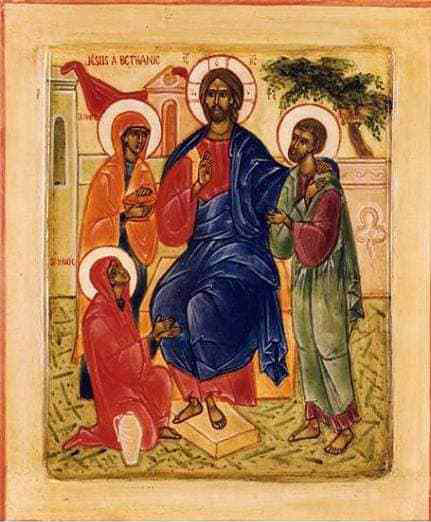
Men and Women in Christ.
Elisabeth Behr-Sigel.


Christ in history was neither a political agitator nor a reformer of the traditional mores of the society in which He was born. Even though He showed himself free from many taboos and prejudices especially with regard to women, Jesus did not spend His time transgressing the customs of His time. "The one thing necessary" for Jesus was the interior turning, conversion, the change of heart that opens the door of the Kingdom: "Repent, for the Kingdom of heaven is at hand." His preaching is summed up in these words, but this change of heart must be ex­pressed in acts, whether it is expressed in ordinary or exceptional circumstances.
Jesus and the Samaritan woman.

Jesus did not encourage women to take on roles or life-styles that were considered masculine in the culture of the time. The women that Jesus associated with busied themselves with household chores and served at table. The number of such women is remarkable, and the gospels often give us their names. They were sometimes prostitutes. However, He did not send the courageous women who had been following him since Galilee back to their husbands and their pots and pans, and in fact, He praised Mary of Bethany who left domestic cares to her sister Martha.

Saturday, May 18, 2019

The hidden spiritual joy.
Abbot Nikon.


Abbot Nikon was born in Russia in 1894. He began to pursue his higher education in the field of medicine-psychiatry, but he became convinced that: true knowledge of man was possible only through knowledge of God. Discontinuing his studies, he began to lead a secluded life, devoting himself to the study of the Gos­pels and the Holy Fathers. Here at last he discovered the "one thing needful."
In 1931 he gave monastic vows, and within a year he was ordained hieromonk. A year later he was sentenced to four years in the Siberian camps. Towards the end of the war, with the re­opening of many churches, Fr. Nikon was assigned first to one parish then to another. Finally he was sent, as though exiled, to the small town of Gzhatsk, where he remained until his death in 1963.

Abbot Nikon.
How are you feeling?! Are you depressed?! We should not fall victim to despondency, grumbling about our illnesses and sor­rows, for God has established a law firmer than heaven and earth, that only through many trials is it possible to enter the Kingdom of God.
We have now come to such a period in the history of humanity when one is saved exclusively through enduring sor­rows without a murmur, with faith in God and hope in His mercy. Today there are no other paths by which to attain salvation. For our times one path alone is left to us: the patient endurance of sorrows. “Saint Isaac the Syrian” writes: "More precious to God than any prayer and sacrifice are sorrows endured because of Him and for His sake.

Saturday, May 11, 2019

Have we found paradise?.
Archimandrite Aimilianos Simonopetra.


On Thursday, May 9, Archimandrite Aimilianos, the former Hegumen of Simonopetra Monastery, and spiritual father of many monks, nuns and lay people, reposed in the Lord, at the Monastery of the Annunciation in Ormylia (Chalkidiki) at the age of 85, after a long illness. Memory Eternal!.

“the Lord God took the man and put him in the garden of Delight to cultivate and keep it” (Gen 2.15).
Archimandrite Aimilianos
 Simonopetra.
 Those plants were like a robe of divine beauty, forming a natural world, a natural expression, of God's majestic holiness. The nat­ural world was a reflection of God's grandeur, and through nature God was visible to the eyes of our first ancestors. In tending the garden they were attending to the glory and majesty of God, care­fully tilling and cultivating the living things around them.
In the first place, then, comes work. We can never experience God without work. People who don't work bard and succeed at their earthly labors are not likely to find much Success in their spir­itual lives. We have to work.
After placing Adam and Eve in the garden, God said to them: “you may eat of any of the trees in paradise” (Gen 2.16). Don't be sur­prised by this. Eating is also a spiritual task, because paradise is a place that relates both to the senses of the body and to those of the intellect. Adam communed with God by means of the fruit of the trees, which was a figure of the food of heaven, about which Christ says: Take, eat, and drink (Mt 26.26-27). By eating of the food of the garden, Adam wasn't merely nourishing his body, but also his soul. It was a way for him to participate in God. And thus when we hear the words: Take, eat, drink, we hear the voice of God calling us to the communion of paradise. But whereas Adam's food was the fruit of the garden, we eat of the bread which came down from heaven (Tn 6.32-35).

Saturday, May 4, 2019

The “Master of Eloquence and silence” between the Silence of Man and the silence of God.


Pastoral Letter of Metropolitan Silouan of Byblos, Botrys and dependencies on the 6th Anniversary of the Kidnapping of His Eminence Metropolitan Paul of Aleppo April 22, 2013-2019

 “God finished on the seventh day His work, which He had done:
and He rested on the seventh day of all His work, which He had made”
(Genesis 2:2)

       
Metropolitan Silouan (Musi).
“Metropolitan Paul of Aleppo is on an ecclesiastical mission.” This is an expression that occurred to me in the first days after Monday, April 22, 2013 (the day he was kidnapped), an expression that opened a window through which I have tried to explore the mystery of that great day, a day of God's work in the history of humanity.
Arriving at the threshold of the seventh year of this invisible “ecclesiastical mission,” we notice that infertility and drying up are encircling us; the infertility of hope and the drying up of inspiration. Consequently, you believe that time is uprooting hope from you, while you have no inspiration regarding how to defend the work of God within us and in us. In that case, how can you possibly defend your hope and your faith, and what may you say regarding this matter? An answer comes to you: “Keep silence!” But how could you manage, with silence, to defend your hope and your faith in this “ecclesiastical mission?”

Saturday, April 27, 2019

Tout en Lui est ressuscité !.
Olivier Clément.


le visage du Christ,
 le visage des visages.

Ce Ressuscité qui nous ressuscite, où le trouver?. où s’unir à Lui jusqu’à devenir avec Lui “un seul corps” et d’“un même sang”?. Certes le Christ est partout, Il aimante secrètement par Sa résurrection l’histoire des hommes et le devenir de l’univers. C’est l’homme-Maximum, comme disait Nicolas de Cuse. Mais le Christ de la seule histoire est un Christ “re-crucifié”. C’est du Ressuscité que j’avais soif.
“Au commencement était le Verbe et le Verbe était (tendu) vers Dieu, et le Verbe était Dieu”(Jn1 : 1), d’où la possibilité paradoxale pour ce Dieu autre que Dieu de sortir de sa transcendance sans l'abolir ni volatiliser l'univers : « Je suis sorti du Père et venu dans le monde » (Jean XVI, 28); la possibilité paradoxale de descendre dans sa propre absence, de “se vider”, de “se dévaster”, comme dit Paul. Pour devenir Job, et la main qui fermait la bouche de Job est désormais trouée. Pour prendre sur la croix, dans l'enfer de la déréliction, Dieu séparé de Dieu, le parti de l'homme. De l'homme nu enseveli dans l'angoisse nue. Mon Dieu, mon Dieu, pourquoi m'as-tu abandonné?

Saturday, April 20, 2019

Why the wise thief was pardoned?.
Saint John Maximovitch.


“And one of the malefactors which were hanging railed on Him, saying, If thou be Christ, save thyself and us. But the other rebuked him, saying, Dost thou not fear God, seeing thou art in the same condemnation? And we indeed justly; for we receive the due reward of our deeds: but this man hath done nothing amiss. And he said unto Jesus, Lord, remember me when Thou contest into Thy kingdom. And Jesus said unto him, Verily I say unto thee, Today shalt thou be with Me in paradise”. (Luke 23:39-13)
"The Crucifixion". Theophanes the Cretan. 16th century.

This Is How the holy Evangelist Luke relates the edifying and moving incident concerning the conversion and the Lord's pardoning of the thief who hung on the cross next to Him on Golgotha.
How did the thief deserve such mercy? What prompted such a quick and definitive response from the Lord? All the righteous figures of the Old Testament, including Saint John the Baptist, were still shut up in Hades. The Lord Himself was preparing to descend into Hades, not, of course, to suffer there, but to bring out the prisoners.
The Lord had not yet promised anyone to lead them into the Kingdom of Heaven; even the Apostles were promised to be taken into His mansions only after He had prepared them.
How is it that a thief was granted such mercy before anyone else? Why were the gates of Heaven opened so quickly for him? Let us examine the soul of the thief and the attendant circumstances.

Saturday, April 13, 2019

Amour et Responsabilité.
Père Dimitri Staniloae.


"J'ai désiré avec ardeur manger cette Pâque avec vous avant de souffrir" (Le 22, 15). 
"Voici que Je me tiens à la porte et que Je frappe; si quelqu'un entend ma voix et ouvre la porte, J'entrerai chez lui pour souper, Moi près de lui et lui près de Moi" (Ap 3, 20). 
"Peuple ingrat, reviens de ton égarement, reconnais Celui que tu as transpercé, vois de quel amour Il t'aime, et te prévient, t'accordant aussi la vie et la résurrection» (Stances du Samedi-Saint, ton 5).

“Jésus aimait Marthe, sa sœur et Lazare”.(Jn11: 5)
C'est un mystère indicible, qui me dépasse. Et, toutefois, c'est un fait que le Fils de Dieu est venu dans le temps en assumant volontiers le besoin de moi, en manifestant un besoin de moi. Il veut que je L'aime. Ce que Dieu nous donne ne serait pas parfait, s'il n'y avait que Lui qui nous aimait, s'Il n'avait pas besoin par bienveillance de notre amour. Là est l'abnégation de Dieu: Il a accepté d'avoir besoin de nous. C'est en cela que se manifeste la valeur indicible et éternelle qu'Il a mise en nous.
L'homme est créé par Dieu avec le sceau de la responsabilité imprimé en lui. Ici est une preuve de l'existence de Dieu. Je suis responsable, je dois répondre à une autorité inconditionnée. Je dois répondre à l'appel de Dieu, pour tout ce que j'ai, pour tout ce qui existe autour de moi, pour moi-même; je dois retourner à-Dieu tout ce qu'Il m'a donné, je dois Lui retourner moi-même. Je parle parce que je dois répondre; ma parole est une parole de réponse.

Saturday, April 6, 2019

On Slander and Condemnation.
Elder Ephraim of Arizona.


Elder Ephraim of Arizona.

Slander is a great evil. Just as the little rudder steers the whole ship wherever it wants, likewise the tongue leads a person either to good or to evil. The holy fathers greatly censure judging other people’s sins, faults, or evil habits. When we judge our brother, we condemn ourselves to a great sin. But when we cover our brother, God will also protect us from great sins. When we expose our brother, we drive the grace of God away from us and He permits us to fall into the same sins so that we learn that we are all weak and that the grace of God supports us. Whoever guards his tongue guards his soul from great sins and grievous falls. The chief cause of criticism and slander is pride and egotism, because one considers oneself better than the others. For this reason it is very beneficial for a person to think of himself as below everyone, so that he considers his brother than him in order that, with the help of God, he may be delivered from this evil.
If something pushes you to criticism in any matter regarding a brother or the monastery, try to pray about the matter instead, without passing it under the judgment of your reason. If you turn within yourself through prayer, humility, and mourning, you will find a spiritual treasure—just keep pride and criticism far from you.