Saturday, September 14, 2019

Orthodoxy and Salvation.
Father James Bernstein.


Father James Bernstein.

Father James Bernstein: Raised in Queens, New York by formerly Orthodox Jewish parents whose faith had been undermined by the Holocaust, Arnold Bernstein went on his own personal quest for spiritual meaning. He was ready to accept God in whatever form He chose to reveal Himself and that form turned out to be Christ. But Bernstein soon perceived discrepancies in the various forms of Protestant belief that surrounded him, and so his quest continued -- this time for the true Church.  In 1981 he and his family were received into the canonical Orthodox Christian Church in America. In 1997 Father James was made Dean of the Pacific Northwest Deanery of the Antiochian Archdiocese, and in 1999 was elevated to the rank of archpriest. In 2017 Fr. James retired as pastor of St. Paul and became priest Emeritus.
Orthodoxy introduces us to a whole spectrum of terminology that spoke of salvation in a non-juridical manner. The Orthodox understand that in Christ's death and Resurrection we are united with Him, not in a legal, positional, or virtual sense, but in a very real, literal sense. This is possible because in the Incarnation, Christ took upon Himself our human nature and united it to His Person. In His Passion, death, Resurrection, and Ascension, the common human nature He shares with us is now glorified.
The Scripture uses imagery that reinforces this concept of organic participation and unity with Christ in His human nature. For example, unity with Christ is presented as being like that between parts of a body. St. Paul often speaks about salvation as being included within the Body of Christ.

Saturday, September 7, 2019

La Mère de la Beauté.
Saint André de Crète.


“Réjouie-Toi beauté des apôtres”.
Fresque au Monastère Saint Jean-Baptiste, Douma, Liban.

       Aujourd’hui comme pour des noces, l’Église se pare de la perle inviolée, de la vraie pureté.
      Aujourd’hui, dans tout l’éclat de sa noblesse immaculée, l’humanité retrouve, grâce aux mains divines, son premier état et son ancienne beauté. Les hontes du péché avaient obscurci la splendeur et les charmes de la nature humaine ; mais, lorsque naît la Mère de celui qui est la Beauté par excellence, cette nature recouvre en elle ses anciens privilèges, elle est façonnée suivant un modèle parfait et entièrement digne de Dieu. Et cette formation est une parfaite restauration et cette restauration est une divinisation et cette divinisation, une assimilation à l’état primitif ...
       Aujourd’hui est apparu l’éclat de la pourpre divine.
       Aujourd’hui, la misérable nature humaine a revêtu la dignité royale.
       Aujourd’hui, selon la prophétie, le sceptre de David a fleuri en même temps que le rameau toujours vert d’Aaron, qui, pour nous a produit le Christ, rameau de la force.
       Aujourd’hui, une jeune vierge est sortie de Juda et de David, portant la marque du règne et du sacerdoce de Celui qui a reçu, suivant l’ordre de Melchisédech, le sacerdoce d’Aaron...
       Aujourd’hui commence la régénération de notre nature, et le monde vieilli, soumis à une transformation divine, reçoit les prémices de la seconde création.


Référence :
http://www.kerit.be/pdf/365_txt_priere.pdf


Saturday, August 31, 2019

Advice from Hell..!!.
Father Arsenie Boca.


Father Arsenie Boca.

Arsenie Boca (29 September 1910 – 28 November 1989) was a Romanian Orthodox monk, theologian, mystic, and artist. He was persecuted by the Communists and named among the 100 greatest Romanians. He was born in Vața de Sus, Hunedoara County, Romania, died at Sinaia M Father Arsenie has not yet been canonized as a saint. Nonetheless pilgrims from all over Romania flock to pray at his grave which is located in Prislop Monastery, Romania.
 In October 2015 the Romanian Orthodox Church announced that it was considering the cause of his recognition and proclamation as a saint.

In an old book from the Holy Mountain, a confessor skilled in giving advice left the following lesson contained in this story:
''A priest fearing God and caring greatly for his flock was daily struggling by all possible means to turn around those lost on the way to perdition, keeping them steadfast in His word. However, he saw with grief that the fruits of his labor were in vain. His flock had dispensed with their hypocrisy but they were still rotting in the .same sins he had found them in. His work, made up of useless sermons, daily counsels or confessions, proved to be in vain. Nothing moved them from the swamp of their sins.
"What was the poor priest to do? How could he set them straight?
Enthusiastic in his labor for God, tormented every day knowing he was responsible for their souls, he entreated God to tell to him why he was incapable of attracting people to repentance.
"One Saturday evening after Vespers, he was resting with sad countenance on a rock in the garden, overwhelmed by his priestly duties, disappointed that his labor bore no fruit. As he was sitting there lost in meditation, behold, God opened the eyes of his troubled soul onto a dreadful vision: a fearsome, armored mob, black as coal, appeared before him in a dark cloud of evil spirits. It was a council of demons led by Satan, the overbearing, frowning master of darkness. Suddenly, from the midst of the council, a devilish voice shrieked, causing the sky to vibrate:

Saturday, August 24, 2019

The devil hates Geronda.!!.
Elder Ephraim of Philotheou and Arizona.


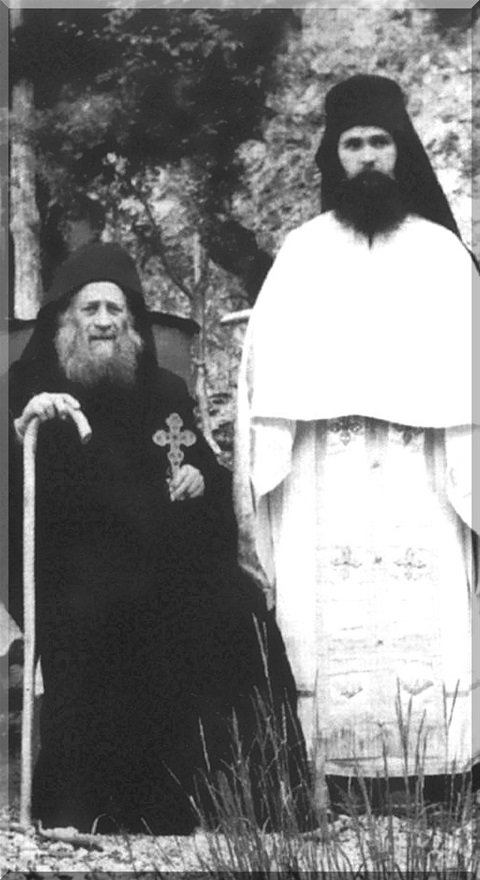
Elder Joseph the Hesychast and 
his disciple Father Ephraim of Arizona.
Elder Joseph the Hesychast was a monk and elder on Mount Athos. He reposed in 1959, and he has wide acclaim for being the spiritual father  of Elders Ephraim of Philotheou, Joseph of Vatopedi, Charalampus of Dionysiou and others, who are directly credited for revitalising six of the twenty monasteries on Mount Athos.

Even the demons know quite well who Elder Joseph was!. When exorcisms were being read over a possessed woman in Thessalonica, she began shouting: "That Joseph! He went to Philotheou. He's protecting Philotheou monastery, and I can't do anything to them!". Everyone who heard this, wondered how she knew about elder Joseph and that his skull was at Philotheou. She herself, of course, didn't know anything, but the demon inside her did!.

Saturday, August 17, 2019

Le Temps de l’Apocalypse.
Père Séraphin de Valaam.


Père Séraphin à la bibliothèque
 du monastère Saint Jean Baptiste
 - Douma - Liban.
Entre le 5-8 Août 2019, le monastère Saint Jean-Baptiste, Douma, Liban, a eu la bénédiction de recevoir, le Père Séraphin, disciple de Père Sophrony Sacharov, starets de Valaam, ancien ami de la communauté. À l’occasion, il a adressé une parole spirituelle, que nous avons la joie de la partager avec nos lecteurs.

L’Écriture Sainte nous dit qu’il y a un temps pour tout sous le soleil. Un temps pour parler, un temps pour être silencieux, un temps pour rire, un temps pour pleurer, un temps pour construire, et un temps pour détruire…
Je pense qu’il nous est donné maintenant le privilège de vivre le temps de la destruction totale, le temps de l’Apocalypse. Père Sophrony disait, il y a environs 30 ans de cela, que bien sûre nous ne savons pas quand la fin du monde va arriver, mais nous pouvons dire une chose de façon sûre absolument, que nous sommes déjà entré dans le temps, le processus de l’Apocalypse. Mais il ajoutait que ce n’est pas pour nous une raison de paniquer, d’avoir peur… Au contraire, il disait que  vivre les derniers temps, c’est un grand privilège!.

Saturday, August 10, 2019

The Church in the world.
Father Georges Florovsky.


Father Georges Florovsky.

 Protopresbyter Georges Vasilievich Florovsky (23 August 1893- 11August1979) was a
prominent 20th century Orthodox Christian priest, theologian, and writer, active in the ecumenical movement. His writing is known for its clear, profound style, covering subjects on nearly every aspect of Church life.

Historical failures of the Church do not obscure the absolute and ultimate character of its challenge, to which it is committed by its very eschatological nature, and it constantly challenges itself.
Historical life and the task of the Church are an anti­nomy, and this antinomy can never be solved or overcome on a historical level. It is rather a permanent hint to what is "to come" hereafter. The antinomy is rooted in the prac­tical alternative which the Church had to face from the very beginning of its historical pilgrimage. Either the Church was to be constituted as an exclusive and "totalitarian" society, endeavoring to satisfy all requirements of the believers, both "temporal" and. "spiritual," paying no attention to the existing order and leaving nothing to the external world­ it would have been an entire separation from the world, an ultimate flight out of it, and a radical denial of any external authority. Or the Church could attempt an inclusive Christianization of the world, subduing the whole of life to Christian rule and authority, to reform and to reorganize secular life on Christian principles, to build the Christian City. In the history of the Church we can trace both solu­tions: a flight to the desert and a construction of the Chris­tian Empire. The first was practiced not only in monasticism of various trends, but in many other Christian groups and denominations. The second was the main line taken by Christians, both in the West and in the East, up to the rise of militant secularism, but even in our days this solu­tion has not lost its hold on many people. But on the whole, both proved unsuccessful. One has, however, to acknowledge the reality of their common problem and the truth of their common purpose. Christianity is not an in­dividualistic religion and it is not only concerned for the "salvation of the soul " Christianity is the Church, i.e. a Community, the New People of God, leading its corporate Life according to its peculiar principles. And this life can­not be split into departments, some of which might have been ruled by any other and heterogeneous principles.

Saturday, August 3, 2019

When Thy Light shines on me.
Saint Symeon the New Theologian.


"In Thy light shall we see light".
(Theophanes the Greek. Late 14th and early 15th centuries)

I weep, I am pierced with sorrow, when the light shines on me,
that I see my poverty and that I realize where I am,
what world I live in, what mortal world, mortal myself;
and I am filled with joy, with bliss, when I understand
what condition God has bestowed upon me, what glory,
and I consider myself like an angel of the Lord
completely adorned with the immaterial garment.
Thus joy kindles my love for the Giver
and the One who transforms me, God - and
love causes streams of tears
to gush forth and makes me still more brilliant.

Saturday, July 27, 2019

L’Amour à l’image du Christ.
Denys Clément*.


les saints Pierre et Fevronia de Murom,
patrons de couples mariés

Il est compliqué de parler de ces sujets dans notre société hyper­sexualisée, où la parole des femmes commence à se libérer. En même temps on sent bien la nécessité d'en parler afin de recadrer ces deux thèmes dans une perspective chrétienne.
Je voudrais différencier plusieurs types de situations,
La première correspond à l’amour sans sexualité ou comment, grâce à l'amour, je m'ouvre complètement à la rencontre de l'autre. Ceci dans une situation vraie et sincère, non fondée sur une séduction qui sous-tendrait une évocation de la sexualité. C'est reconnaître l'altérité de l'autre, dépouillé de toute sexualité. Reconnaître l'autre comme une personne pleine et entière. S'ouvrir ainsi à l'autre nous dépasse et nous élève. Actuellement on parle beaucoup d'empathie, de bienveillance mais une approche chrétienne de l'autre dépasse toute dimension immanente peur nous ouvrir à la transcendance de la rencontre avec le Christ dans l'autre: «Aimez-vous les uns les autres». C'est le sens même de cet amour sans sexualité. C'est aussi l'image du Christ qui est là, qui nous aime, mais c'est à nous de nous ouvrir à son amour. Une ouverture à l'autre et à travers lui, au Christ, lui permet de se sentir pleinement reconnu, de se sentir pleinement exister pour ce qu'il est et non pas pour ce qu'il donne à voir ou paraître. Cette rencontre passe par une présence à l'autre qui peut être, qui doit être, inspirée par le Saint-Esprit. Une présence lumineuse de la confiance en Christ, à la fois pour nous-mêmes, afin qu'Il nous donne la force d'oser nous ouvrir à l'autre, et en l'autre, où nous devons oser Le rencontrer ici et maintenant. Cet autre qui est à l'image du Christ et qui devient pleinement humain dans cette rencontre authentique.
En deuxième point, je voudrais parler de l'amour avec la sexualité.
Vrai prolongement de la rencontre avec un autre, c'est l’ouverture au plus intime de nous-mêmes, c’est la reconnaissance de l'autre non seulement par sa présence mais aussi par son corps. C’est l'acceptation complète de la vulnérabilité de chacun qui est magnifiée, transfigurée dans l'étreinte amoureuse. C'est retrouver un fragment de ce jardin d'Éden perdu où Adam et Ève vivaient nus sans avoir honte. Ces corps qui communient l'un à l'autre dans la lumière de leur amour donnent le goût, dans notre vie terrestre, de ce que peut être l'immensité, la profondeur de l'amour du Christ pour nous.
Noces d'un couple Orthodoxe Roumain,
en Amérique.
C’est une vraie révélation qui nous rend palpable l'impalpable. Le Christ s’est incarné et a pris sur Lui toute notre humanité, dont notre corps. Notre corps et sa dimension sexuelle sont partie prenante de notre humanité. Dans un amour vrai et profond, avec un respect mutuel, la sexualité est une expression de cet amour. Nous ne devons pas avoir honte de la sexualité. Elle évolue avec l'âge au sein du couple, mais demeure le témoignage de cette reconnaissance complète de l'autre dans la globalité de son être et de son corps. De cette ouverture à l'autre, notamment à travers nos fragilités (qui peuvent être corporelles et en rapport avec la sexualité) naît la confiance en l'autre.Cette confiance en l'autre, et à travers lui au Christ, permet de cheminer ensemble jusqu'au bout.
Enfin il y a la sexualité sans amour. Là, nous touchons au néant. Cette situation est d'autant plus vide que l'amour avec sexualité est plein. La sexualité sans amour, c’est une réduction de l'autre à un simple organe sexuel. Cette réduction, on le voit, on le sent, est purement égoïste: je suis tourné uniquement sur mon propre plaisir. L’acte sexuel devient une performance physique normée par les codes de la pornographie. Où est l'homme, où est la femme? Où est la reconnaissance de l'autre dans sa globalité où est la reconnaissance du Christ dans l'autre?
Cette réduction de l'autre est une négation de l'image du Christ qui est en chacun d'entre nous. Dans cette sexualité perdue, il faut veiller au moins au respect de notre propre intégrité physique et morale, ce qui veut dire que je dois respecter mon corps comme je dois respecter le corps de l'autre et donc que je commence à m'éveiller à la notion d'altérité(qualité de ce qui est autre).
  
*Denys Clément : médecin orthodoxe français

Référence :
Revue “Contact”. LXXIe Année. Janvier-Mars 2019 .